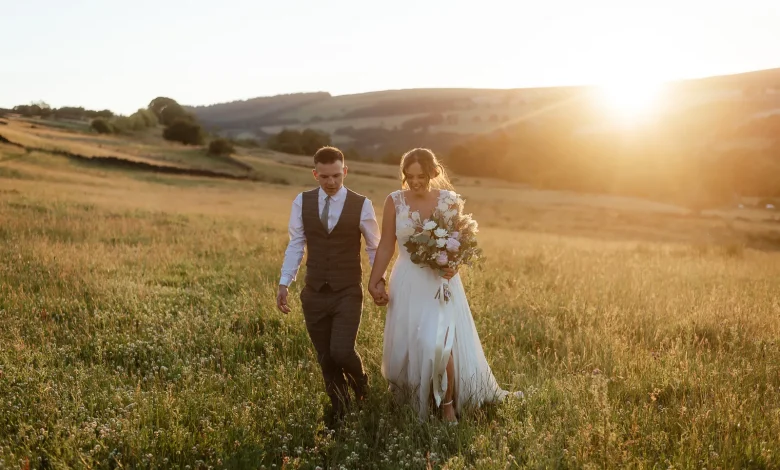
The final hour before sunset is often treated as an insurance policy. Photographers breathe a quiet sigh of relief when the harsh midday sun drops, knowing that the impending warmth will soften skin tones, suppress harsh shadows, and lend an automatic romanticism to almost any frame. Yet relying on golden hour merely as a flattering filter leaves its true creative potential untapped.
When the sun drops below fifteen degrees, the outdoor environment transforms into a dynamic studio where the quality, color temperature, and angle of light change every three to five minutes. Instead of simply turning couples directly away from the sun for an easy backlight, approaching this window with deliberate editorial concepts yields images that feel layered, cinematic, and timeless. Moving from safe execution to intentional artistry requires understanding how low-angle solar rays interact with landscape geometry, textile textures, and raw human movement.
Sculpting with Directional Angles Instead of Default Backlighting
The default instinct during golden hour is almost universal: place the sun directly behind the couple, blow out the background into a sea of amber bokeh, and lift the shadows in post-production. While this delivers the classic dreamy aesthetic, it overlooks the sculptural drama of other directional angles.
Low-Rake Side Lighting
Positioning your subjects at an approximate eighty to ninety-degree angle relative to the setting sun introduces dimensional modeling that backlighting eliminates. As the light skims across the couple, it defines facial structure, catches the intricate embroidery of a bodice, and carves out the folds of tailored suiting. The key lies in balancing the shadow side. Rather than filling the shadows with heavy flash, allow natural environmental bounce—from dry grass, pale sand, or a nearby light-colored wall—to provide subtle, organic fill. This preserves dramatic contrast while keeping the shadows clean and noise-free.
Direct Low-Sun Portraiture
Turning the couple directly toward the sun in its final fifteen minutes of visibility produces a look reminiscent of classic mid-century cinema. At this stage, the light has traveled through maximum atmospheric density, stripping away harsh ultraviolet wavelengths and leaving behind an extraordinarily gentle, rich illumination. Direct light at this hour does not cause squinting if the sun is hovering right at the horizon or partially filtered through distant tree lines. Skin appears to glow from within, catchlights in the eyes become wide and luminous, and the backdrop falls into naturally deeper tones, isolating the subjects without artificial vignettes.
Harnessing Environmental Contrast and Color Temperature Splits
Golden hour is not just about warm tones; it is about the striking visual tension between warm highlights and cool shadows. Photographers who lock their white balance to a single warm preset across an entire shoot often flatten this natural color depth.
When the sun is low, areas that fall into shade are illuminated almost exclusively by the ambient blue sky overhead. This creates an innate color temperature split: highlights register at roughly 3,000 to 3,500 Kelvin, while deep shade registers closer to 7,000 to 8,000 Kelvin.
To maximize this contrast:
-
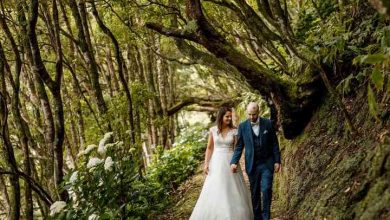
Position the couple along shadow boundaries. Place your subjects right on the dividing line where golden light hits their hair and shoulders while their backdrop rests entirely in deep, shaded foliage or mountain shadows.
-
Seek dark, light-absorbent backdrops. Golden rim light vanishes against bright sky backgrounds. To make the outline of a flying veil or stray wisps of hair pop, drop your perspective so the couple is framed against shadowed hills, dense timber, or dark architectural stone.
-
Preserve the cyan and lavender shadow tones in your color grade. Resist the urge to push warmth into the shadows. Retaining cool, rich tones in darker values makes the golden highlights on skin and fabric appear significantly warmer by comparison.
Choreographing Kinetic Movement Within the Golden Beam
Stiff, static posing feels particularly unnatural when bathed in warm, ethereal light. Golden hour has an intrinsic sense of ephemerality—the viewer knows the light is fading—and movement accentuates that narrative quality.
Instead of micro-adjusting hands and chin angles, design loose choreography that encourages the couple to traverse the light. Have them walk briskly through alternating patches of light and shade created by intervening trees or buildings. This rhythmic flashing of sunlight hitting the lens and your subjects creates an authentic documentary feel that cannot be replicated through static posing.
Pay particular attention to garments with natural flow. Silk tulle, open-weave linens, raw-edge ribbons, and veil fabrics catch low-angle light in spectacular fashion, transforming into luminous elements that lead the viewer’s eye through the composition. Instruct the couple to move in directions that allow the wind to carry these elements across the beam of sunlight, turning transparent textiles into radiant framing devices.
Advanced Flare Modulation and Lens Geometry
Lens flare can either elevate an image into high-end editorial territory or wash out detail into an unusable, muddy haze. The difference comes down to mechanical modulation at the edge of your lens element.
Rather than aiming the camera straight into the unobstructed sun, use the environment as a natural gobo to clip the light source:
-
The Shoulder Eclipse: Hide ninety-five percent of the sun behind the groom’s shoulder or the bride’s hip, allowing just a fraction of the solar disc to breach the silhouette. This triggers a controlled, sharp prism flare or an intense rim of light while retaining full contrast and deep blacks throughout the rest of the frame.
-
Foreground Occlusion: Shoot through intervening environmental elements such as tall field grasses, olive branches, or the sheer edge of a veil held close to the front lens element. These elements catch the light, creating soft, abstract foreground flares that build visual depth, making the viewer feel as though they are peering into a private, unguarded moment.
-
Aperture Trade-offs: Wide-open apertures like f/1.4 or f/1.8 produce soft, circular flare rings and painterly background melt, which flatters intimate portraits. However, stopping down to f/4 or f/5.6 increases micro-contrast, keeps the couple’s eyes tack-sharp, and turns stray light points into subtle, controlled starbursts that feel structural rather than accidental.
Capitalizing on Atmospheric Particulates
Golden light requires something physical to cling to in order to produce that coveted cinematic haze. Crisp, clean air often yields bright, sharp light, but it lacks the moody atmosphere found in textured environments.
Keep an eye out for atmospheric particles that catch the low sun:
-
Coastal marine layer and sea spray: Near the ocean, pulverized salt and mist hang suspended in the air. When lit from behind, this moisture turns into a luminous fog that separates foreground subjects from background headlands.
-
Agricultural dust and dry soil: In vineyard or ranch settings, ask the couple to walk or dance across dirt paths or dry fields. The minute dust kicked up by their movement catches the golden rays, generating immediate depth and ambient glow behind them.
-
Pollen and humidity: Summer evenings in wooded or meadow environments often feature heavy pollen counts and high humidity, which can be emphasized by shooting slightly upward toward the canopy where the sun breaks through leaves.
Extending the Window: The Blue Hour Transition
The most significant mistake in sunset wedding coverage is packing up gear the moment the sun dips below the horizon. The fifteen to thirty minutes that immediately follow—civil twilight, or blue hour—offer the most balanced, sophisticated light of the entire day.
Once the direct sun vanishes, the sky turns into a giant, ambient softbox. Contrast drops dramatically, eliminating any risk of blown highlights on bridal gowns. The light wraps evenly around faces, rendering skin tones with painterly smoothness.
Use this post-sunset period for expansive landscape portraits. Without the blinding glare of the sun dominating your camera sensor, you can expose cleanly for the rich pinks, purples, and deep indigos in the evening sky while maintaining full, luminous detail across your couple. The frantic pace of chasing direct golden rays subsides, providing space for quiet, contemplative frames that close out the wedding narrative with emotional resonance.
Approaching golden hour as a nuanced interplay of direction, contrast, and atmosphere transforms standard wedding portraits into fine-art editorial pieces. By anticipating how the sun’s descending arc alters exposure ratios and environmental color, you can work through that brief, frantic window with calm, deliberate mastery.